 Dark Discoveries
Body + health · 70 seconds
What Happens To Your Body If You Stop Sleeping
After one sleepless night, your brain is drunk.
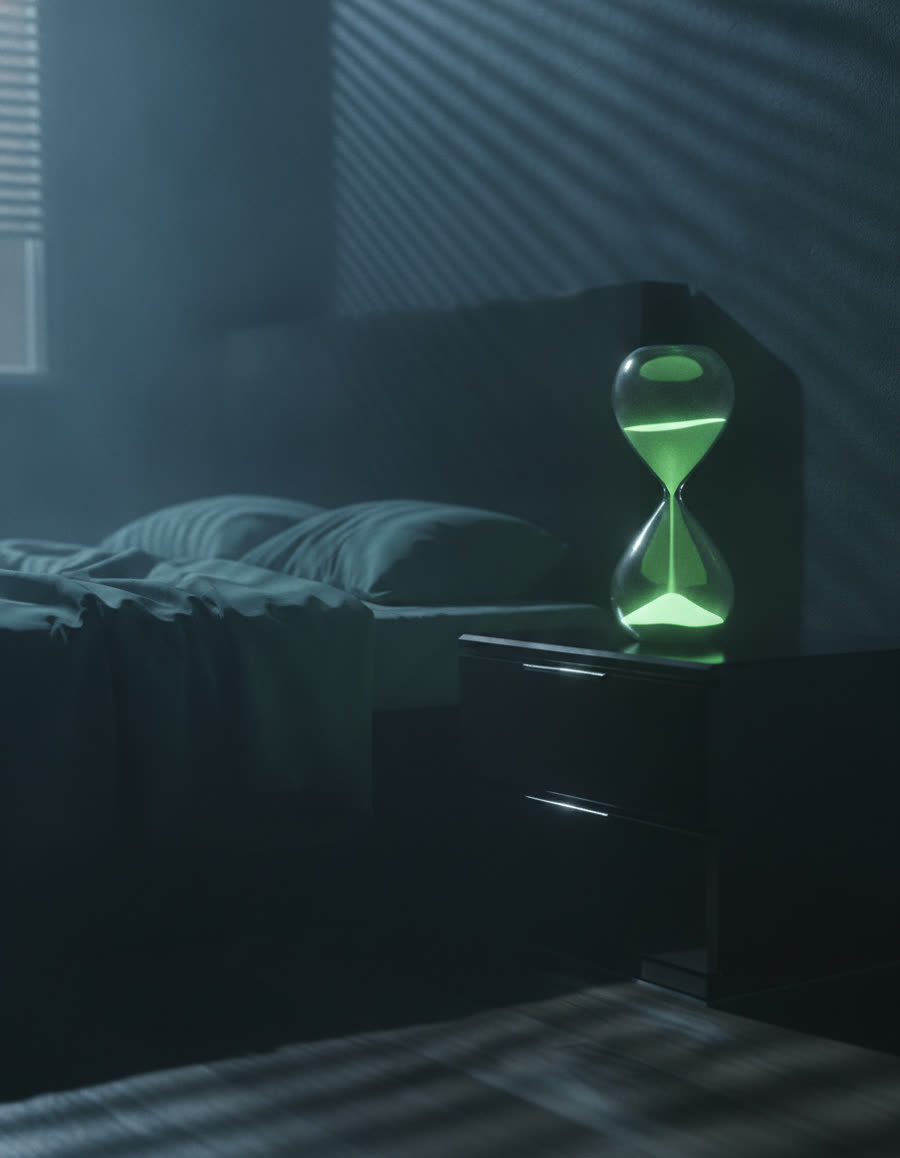
Seventeen hours awake.
Stay awake for seventeen hours and performance can resemble a blood alcohol level around 0.05%; after a full day awake, about 0.10% in the Dawson & Reid comparison.
Source: Dawson & Reid, Nature 1997; Williamson & Feyer 2000.
Trash starts piling up.
One night of sleep deprivation was associated with an approximately 5% rise in brain beta-amyloid in a PET study.
Source: Shokri-Kojori et al., PNAS 2018.
Your eyes give you away.
Observers rated sleep-deprived faces as having droopier eyelids, redder and more swollen eyes, darker circles, paler skin and more wrinkles.
Source: Sundelin et al., Sleep 2013.
Microsleeps, then hallucinations.
After extended wakefulness, local parts of the brain can enter sleep-like states while the eyes remain open. Around three days of total deprivation, hallucinations have been reported in a systematic review.
Source: Nir et al., Nature Medicine 2017; Vyazovskiy et al., Nature 2011; Waters et al., Frontiers in Psychiatry 2018.
The experiment ends badly.
Randy Gardner remained awake for about 264 hours in 1964. Totally sleep-deprived rats died in roughly two to three weeks. Fatal familial insomnia is a rare prion disease that is invariably fatal.
Source: Ross, American Journal of Psychiatry 1965; Rechtschaffen et al., Sleep 1989; NIH GARD/NORD.
FAQ
Is sleep deprivation medical advice?
No. This is a research summary. If you cannot sleep, talk with a qualified clinician.
What should I do after a sleepless night?
Do not drive if impaired, and seek professional advice for persistent sleep problems.